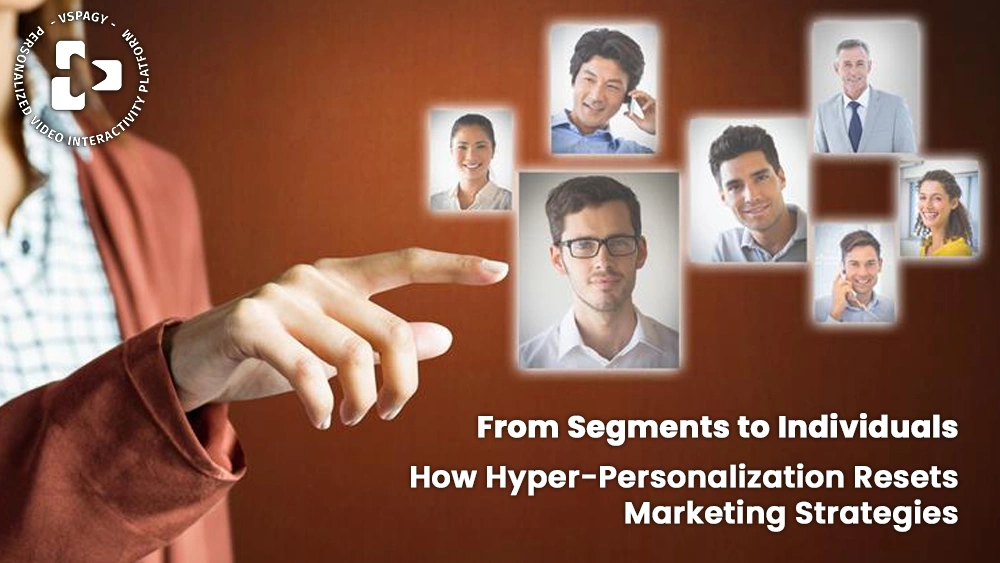
From Segments to Individuals: How Hyper-Personalization Resets Marketing Strategies
Jan 12, 2026
Introduction
Marketing has now gone through a major change. Over the years, brands used segments of the population to determine campaigns on the premise that similarities resulted in similar intentions. It is no longer the case.
The consumers of this day seek to experience themselves, rather than the group within which they live. This shift has increased the pace of using hyper personalized video messages, in which communication is tailored to the circumstances of the individual and not to fixed segments.
Online users can no longer judge interactions based on the highest experiences they have had in other places. Messages that are generic or slow to receive are immediately unengaging.
Hyper-personalization is a reaction to this fact because it changes the way brands are communicated, and instead of general targeting, it offers relevance at a personal level. With the maturity of technology, marketing has been rebuilt on the basis of people and not profiles.
Why Traditional Segmentation Is No Longer Enough
Segmentation of the audience is used to provide order and efficiency. The ability to group users based on age, location, or interest scaled communication by the brand. But the behavior of today rarely falls into any rigid categories. Consumers change their tastes fast, cross-channel, and demand that brands be on time.
The idea of segment-based messaging tends to be outdated since it suggests the intent rather than the observation. Even in the same segment, two individuals can desire completely different results at a given time. It is this gap that becomes weak in terms of engagement. Even well-produced messages seem out of touch with reality.
With the increase in expectations on personalization, segmentation is not a differentiating factor but a starting point. Brands can no longer afford to be reacting to live behavior, context, and timing rather than presumptions established within segments.
Understanding Hyper-Personalization in Modern Marketing
Hyper-personalization goes beyond superficial personalization. It does not target groups differently but customizes communication to each person using actual cues like history of interaction, time, and purpose. This practice facilitates responsive experiences as opposed to planned experiences.
Hyper personalized video messages lie at the heart of this change and adapt the story, tone, and presentation to the individual viewer. These videos develop depending on the way people interact, as opposed to sending the same content with slight modifications. The experience seems personal, purposeful, and important.
The same shift also brings the concept of hyper individualization, in which marketing is now no longer predictive in its behaviour, but responsive to it. Message making is an interactional process, not a preparation. This is a radical re-design in the marketing strategy design.
Personalized vs Individualized: A Strategic Distinction
The debate on whether the experiences are personalized or individualized is the most critical issue in modern marketing. Personalization is often based on known details to personalize content, e.g., the recommendation of products based on historical behavior. Although it works well, it is within predetermined regulations.
Individualization, on the other hand, is a continuous adaptation. Content is a response to the behavior of the individual in the present, and not how they used to behave in the past. This difference is important since viewers are getting more sensitive to experiences that are automatized or templated.
Knowledge of this difference would assist brands in avoiding hyper-engineered communications. Individualized experiences are natural since they develop naturally, and communication can thus remain in sync with the evolving needs as opposed to predetermined assumptions.
The Role of Video in Hyper-Personalized Marketing
Video has turned out to be the best way of emotional engagement, clarity, and narration. In combination with hyper-personalization, it becomes a conversation rather than a broadcasting tool. A personalized marketing video will be able to instruct, clarify, or comfort in a manner that static forms will not.
Video enables brands to express subtlety in the tone, tempo, and images. When these elements are changed to suit the viewer, it becomes more human. Rather than being spectators, viewers feel appreciated.
The strategy also enhances the retention of messages. The longer the viewers watch something that fits into their context, the longer they will listen to it and remember. The video personalization facilitates both the interaction and comprehension without the need to add more messages.
How Video Personalization Resets Engagement Expectations
Consumers nowadays are judging each interaction by relevance. Video personalization makes them more demanding as it shows that they are thoughtful without being obtrusive. When properly done, it eliminates friction instead of complexity.
Video experiences are hyper-personalized, which means that the messages are customized to the viewer's moment of the viewer. They focus on conciseness rather than length and topicality rather than breadth. This minimizes fatigue, and trust is established, particularly in settings where focus is insufficient.
The more these experiences are shared, the more unrelated generic video messaging becomes. Those brands that do not adapt will be seen as careless, no matter how good the production is.
Where Hyper-Personalized Video Delivers the Most Value
Hyper-personalized video works best at times when it is needed to comprehend and at the right time. The onboarding experiences become more evident when the content is changed according to what a person requires at the moment. Explanations of products are less intimidating with the information that is equal to real use.
The other area of impact is re-engagement. Contextually aware messages are respectful, as opposed to intrusive. This will build relationships rather than coerce action.
In all these touchpoints, hyper personalized video messages will substitute repetitive communication with meaningful interaction, which will be used to support long-term engagement and not short-term clicks.
Balancing Technology with Trust
Although personalization increases relevance, it should be used in a responsible way. Using data too much is intrusive, even when it is with good intentions. Relevance is as much as restraint is a key to trust.
Effective hyper-personalization is concerned with utility, rather than exposure. The experiences are to be supportive and not observant. This balance will make sure that personalization enhances relationships and does not weaken them.
The basic principle is authenticity. Technology must enhance knowledge and not substitute it. As long as the viewers are treated with respect, personalization is a virtue and not an issue.
The Future of Marketing Beyond Segments
Marketing strategies are moving away from predicting behavior to responding to behavior. With the growth of hyper-personalization, targeting will be replaced by listening. Interaction will determine experiences and not assumptions.
The shift of segments to individuals is not just a tactical shift. It is an even greater change in the relationship between brands and people. Communication becomes responsive, timely, and human.
Relevance that is delivered with empathy will be the key to success in the future. The next phase of marketing will involve strategies that are developed around people and not categories.
The Bottom Line
The shift toward personal campaigns, as opposed to segmented campaigns, is a major shift in marketing. This change is embodied through hyper personalized video messages that offer relevance at the right time.
With more and more audience becoming picky, brands have to consider understanding rather than scale. Hyper-personalization helps to form relationships naturally, as it allows people to communicate in a personal way without making it sound forced.
The future of marketing lies in the approaches that will not consider people as points of data. In the fast-moving digital environment, brands can be relevant, trusted, and truly connected by adopting hyper-individualized experiences.
Frequently Asked Questions
Why is traditional audience segmentation no longer sufficient?
Traditional segmentation relies on assumptions based on age, location, or interests. Modern consumer behavior is dynamic and unpredictable, making static segments less effective at delivering timely and relevant experiences.
What is hyper-personalization in marketing?
Hyper-personalization is the practice of tailoring communication to an individual using real-time data, behavior, and context. Instead of predefined rules, it enables responsive and relevant experiences that adapt as the individual interacts.
How is hyper-personalization different from basic personalization?
Basic personalization uses historical or fixed data, such as names or past purchases. Hyper-personalization continuously adapts content based on current behavior, timing, and intent, making interactions more relevant and natural.
Is hyper-personalization intrusive for consumers?
When done responsibly, hyper-personalization enhances trust rather than violating it. The key is focusing on usefulness and relevance while respecting privacy and avoiding overuse of personal data.
Why is hyper-individualization important for long-term brand success?
Hyper-individualization enables brands to form genuine relationships by responding to people as individuals. This approach builds trust, relevance, and loyalty in a fast-changing digital environment.
Recommended Articles:
Checkout other stories